WDM
Wavelength Division Multiplexing
The basics of WDM
What is WDM?
The IT refers to a medium where information is transmitted via a link. If two locations want to communicate with each other, one link is sufficient. To connect more locations more links are required. What if only one link e.g. between two cities is available, but more applications shall be connected? Using the WDM technology, fiber optic links can be utilized for data transmission more efficiently.
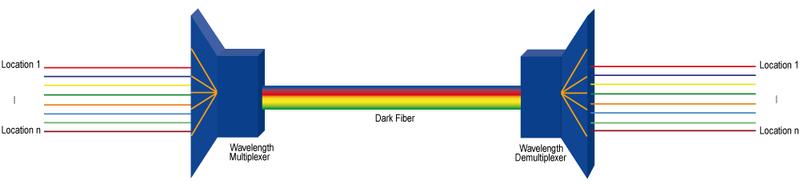
The idea of xWDM technology
Each application is allocated to a dedicated color (wavelength) to communicate with a remote station. The advantage is that different colors can be simultaneously transmitted using one pair of fiber. For this purpose a multiplexer combines all different colors which will then be transmitted to the remote station over one pair of fiber. At the remote site the combined signal is separated again into different colors by a demultiplexer. Generally only one light beam with one wavelength is transferred over a pair of fiber. The wavelength multiplexing technology provides the ability to transmit more light beams, each having different wavelengths, using the same optical link. Due to the fact that wavelengths do not interfere, single light beams can be separated from each other using simple filters. A laser serves as the source of light and light-sensitive diode as receiver unit. Wavelength multiplexing is differentiated in CWDM (Coarse Wavelength Division Multiplexing) and DWDM (Dense Wavelength Division Multiplexing) technology. Advantage: With the use of WDM, it is possible to transfer nearly 1 Tbps (C-band) via one pair of fiber today.
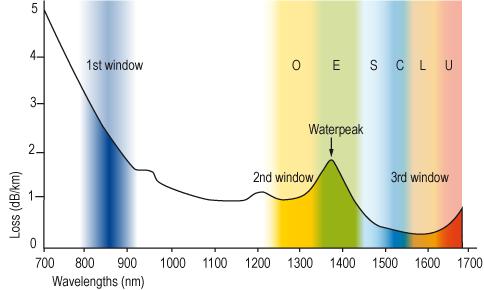
Choosing of the appropriate wavelength
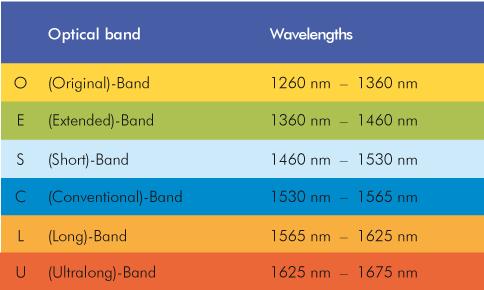
By the use of appropriate transceivers (SFP, XFP etc.) with different power budget ranges from a few 100 m up to 160 km can be achieved. A major factor in the range is - next to the power budget of the transceiver - the used wavelength as a fiber has a specific attenuation behaviour for each wavelength. The higher the attenuation, the lower the overall distance. With a careful selection of the wavelength a higher range and better signal quality can be achieved.

More Informations
References


Full redundancy regarding mission critical Ethernet and Storage applications to Theo backup data center


We have been using Pan Dacom Direkt products for our business connections on the Frankfurt airport site for years and are enthusiastic about the stability of the systems.
Klaus Schultz-Fademrecht (Senior Manager Networks, Fraport AG)


In addition to the optimal price / performance ratio of the SPEED-OTS 5000 system, we were impressed by the quick and easy commissioning and the good support.
Jochen Brünger (Leiter Informatik Produktion)


Our goal was to get an easy-to-use WDM system in order to connect our data center locations, which we can also scale in the future. In addition to the top advice and the good price-performance ratio, the very good References convinced us


The excellent price-performance ratio compared to the competition and the impressive references in the market were decisive for the purchase of the SPEED-OTS 500 system.


Ring-shaped, redundant connections from the production studios Freimann and Unterföhring to the Funkhaus location. In addition to company-wide telecom and IT-services such as 10 Gigabit Ethernet, STM-64 and 8G Fiber Channel, radio-specific ones also were supported.


The cooperation with Pan Dacom Direkt GmbH has been characterized by speed, reliability and stability for years. This, coupled with good cost efficiency and scalability, is the basis for the long-term partnership.
Gunnar Jäger (Geschäftsführer, Diebold Nixdorf Portavis GmbH)


Thanks to the professional advice and on-site inspection by Pan Dacom Direkt, we were once again able to save costs when networking our locations.


Together we have reached another milestone in the expansion of telecommunications. The fiber optic networking via deep-sea cables and the active transmissions in combination with the 24/7 monitoring enable us to quickly network our locations.
Diter Gruber, Netzwerkingeningeniuer Stadtwerke Konstanz


For the highest possible security against eavesdropping on our fiber optic cables and cable ducts, we rely on the infrastructure monitoring of Pan Dacom Direkt GmbH
Michael Cremer, Sales Manager WINGAS GmbH


We were impressed by the quick and easy installation by the Pan Dacom Direct Service Team, who implemented the networking of the data centers in less than 5 days
Severin Braun, Director Operations PlusServer GmbH


High-speed network FAIR Tera Net for research relies on the WDM system from Pan Dacom Direkt GmbH


Redundant structure of the existing connection of three switch nodes as well as increasing the data rate to 10GE or 40GE.


The system structure of the passive CWDM-modules, as well as the very good specifications of the WDM-filters, are decisive for us and enable a successive network expansion with the high-quality CWDM-optics.
Michael Philipp (Stellvertretender Direktor URZ)


Cooperation with the Pan Dacom Direkt team is always professional, uncomplicated and effective, starting with advice, planning, right through to technical implementation and support.
Frank Horst (Systemingenieur, ODN)


Through direct contact with the German-speaking Pan Dacom Direkt R&D department, we have managed to gradually replace a discontinued system with a system developed by Pan Dacom Direkt.
Fritz Röttenbacher (Head of Purchasing)


The SPEED-OTS 5000 convinced us with its individual and uninterruptible expandability, an optimal price-performance ratio and the reliable support from the German manufacturer.


The individual solution development, the attractive price and future expansions of the SPEED-OTS 5000 series from 4GFC were without hardware exchange


In connection with the service of Pan Dacom Direkt, we can offer our customers tailor-made services at attractive prices.
Lothar Maximini (Leiter Übertragungstechnik)


The successful proof of concept of the Cisco Nexus series and the SPEED-OTS 5000 series convinced us.The system has been running stable for years now and exceeds our expectations regarding reliability.
Jörg Huber (Leiter IT-Systems, Bankhaus Metzler)


Thanks to the flexible and tailored interconnection of CWDM and DWDM modules, the SPEED-OTS 5000 system adapts to our network structure and our needs.
Harald Singer (IP-Technik, Teledata GmbH)


We are constantly expanding our cross-city data center coupling.Our long-term partner Pan Dacom Direkt supports us with great advice, quick feedback and short delivery times.
Rüdiger Kopf (Stadt Freiburg)


Use of the SPEED-OTS 5000 series to support 10Gbps Ethernet signals via DWDM.
Thorleif Wiik (Vorstand Technik)


